In this article
- What is an American title?
- What does a clean title mean on a Harley-Davidson?
- What is a title brand?
- What does a salvage title mean on a Harley-Davidson?
- Why is a Harley sometimes declared a total loss so quickly?
- Is a Harley with a salvage title always bad?
- What does a rebuilt or reconstructed title mean?
- What is a flood title?
- Can a salvage history disappear?
- Why are old auction photos so interesting?
- How do I check an American Harley?
- Can an American salvage Harley be registered in Europe?
- Clean title or salvage title: look at the whole story
- That’s why Harley’s Enzo includes the available history
- Frequently asked questions
What is an American title?
In Europe we know the registration certificate. In America registration works differently.
The individual US states largely handle vehicle registration themselves. A state can issue a Certificate of Title for a motorcycle.
This title contains important details about the bike and the owner. The VIN, the Vehicle Identification Number, plays an important role in this.
A Harley may also have been registered in several states during its life. A bike may, for example, have been sold new in California. Then the owner moves to Arizona. A few years later the bike is sold to someone in Nevada.
Part of that history can show up in an American VIN check. That’s why when buying a Harley I don’t just look at the current title. The history behind the VIN is at least as interesting.
What does a clean title mean on a Harley-Davidson?
A term you often come across is clean title. In simple words this means the current title carries no brand such as salvage, rebuilt or flood.
Still, a misunderstanding often arises here. A clean title doesn’t automatically mean a Harley-Davidson has never had damage.
Say an owner drops his Harley. The tank, exhaust and handlebars get damaged. The owner then repairs the bike himself and doesn’t file an insurance claim. In that case the damage doesn’t have to be officially recorded anywhere.
The same applies to many other repairs. A fender may have been repainted. A fairing may have been replaced. Damaged parts can also be replaced without it showing up in an American database.
That’s why I never just look at the words clean title. I also check the bike itself.
What is a title brand?
An American title can get a so-called brand. That is an official designation that tells you something about an event or status in the vehicle’s past.
- Salvage
- Rebuilt or reconstructed
- Flood
- Junk
An important source for this is the US National Motor Vehicle Title Information System, better known as NMVTIS. At NMVTIS from the US Department of Justice you can read more about the American system.
NMVTIS collects information from various sources. These include US vehicle registrations, insurers, salvage companies and recyclers. Motorcycles can also appear in NMVTIS.
Clean title: No brand such as salvage, rebuilt or flood, but no guarantee that the bike has never had damage.
Salvage title: The bike was once declared an economic total loss, for example after an accident, theft, fire or water damage.
Rebuilt / reconstructed: A vehicle with an earlier salvage status that was then repaired and, depending on the state, inspected again.
Flood: Indicates recorded water or flood damage, extra important with the electronics of modern Harleys.
VIN history: NMVTIS can show an earlier brand even if the current title looks clean. That’s how I check for title washing.
What does a salvage title mean on a Harley-Davidson?
A salvage title on a Harley-Davidson means there is an important event in the recorded history of the bike.
- An accident
- Theft
- Fire damage
- Water damage
- Or a total loss decision
The exact rules differ per US state. So a salvage title doesn’t have to have exactly the same background everywhere in America.
With insurance damage the value of the bike also plays a big role. Say an older Harley is worth $10,000 before an accident. The bike has damage to the fairing, tank, saddlebags and exhaust. On top of that come parts and labour costs.
The repair can then become so expensive that an insurer decides to declare the bike an economic total loss. That doesn’t automatically mean the bike is technically beyond repair.
Why is a Harley sometimes declared a total loss so quickly?
Harley-Davidson parts can be quite expensive. On top of that, labour costs in America are often high. So a damage amount can add up quickly.
A bike may, for example, fall on its side. A fairing, saddlebag, crash bar, exhaust and tank get damaged. Technically the bike may still be fine. For an insurance company, repair can still be too expensive.
That’s why the word salvage alone doesn’t say enough. Above all I want to know: why did this Harley get a salvage title and what was the original damage? That tells me much more.
Is a Harley with a salvage title always bad?
No. A Harley-Davidson with a salvage title doesn’t automatically have to be a bad bike. But you do need to know what happened.
A Harley with cosmetic damage is something very different from a bike that had heavy frame damage.
That’s why I look at the complete situation. What does the frame look like? Are there signs of welding or repairs? How are the wheels aligned? Which parts were replaced? And does the current condition match the known history? Old photos can help with this too.
I’d rather buy a bike whose earlier damage is clearly known than a bike whose story doesn’t add up. Transparency matters more to me than just the word clean on a document.
What does a rebuilt or reconstructed title mean?
Besides salvage you may also come across terms like rebuilt and reconstructed. Broadly, this is a vehicle that previously had a salvage status and was then repaired.
The vehicle can then be inspected or registered again under the rules of the US state concerned. The exact procedure differs per state, though.
So a rebuilt title from one state doesn’t automatically mean exactly the same procedure was followed as in another state. Here too, the VIN history is important.
What is a flood title?
Another designation you may come across is flood. This indicates a recorded history of water or flood damage. With a Harley I’d look at that extra carefully.
Modern Harley-Davidsons have quite a lot of electronics: modules, sensors, wiring and electrical connectors. Water can cause problems there later.
A bike may start and run fine today. Still, you want to know whether it had serious water damage before. That’s why this information is also important when assessing an American Harley.
Can a salvage history disappear?
Just looking at the current American title is not always enough. That’s why I also check the available history behind the VIN.
NMVTIS keeps known brand history. An earlier salvage or other brand can therefore remain visible in the vehicle history. That’s important to combat so-called title washing.
With title washing someone tries to make a problematic history less visible. That can happen, for example, by re-registering a vehicle in another state.
So a VIN check can show information you don’t immediately get from the current document. Want to know more? Then also read our blog on CARFAX and VIN check on a Harley-Davidson from America. There I explain which American systems exist and what information you can get from a VIN check.
Why are old auction photos so interesting?
Many damaged vehicles in America are sold through auctions. If a Harley has been at such an auction before, old photos sometimes still exist.
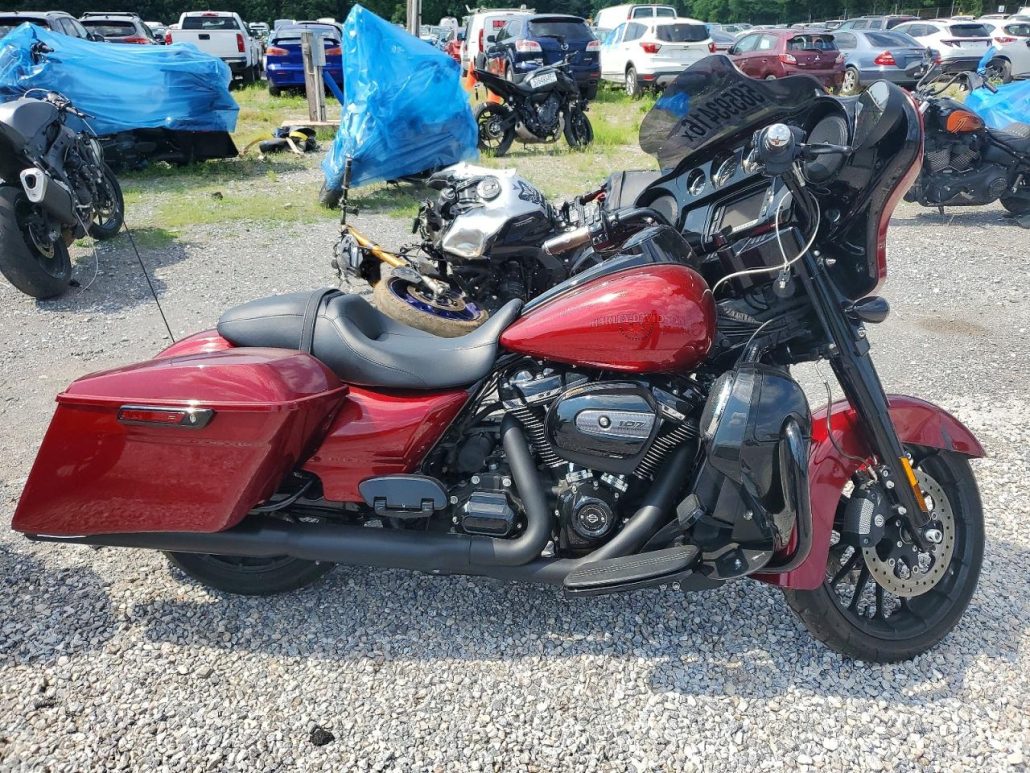
Those photos can tell a lot. You can see, for example, whether the bike lay on its left or right side. Sometimes you can also see whether the fairing, front fork, tank or saddlebags were damaged.
You can also compare the old situation with the bike as it is now. That gives much more information than just the words salvage title.
That’s why, when possible, I look for information about the bike’s past.
How do I check an American Harley?
At Harley’s Enzo I look at three important parts.
First I check the bike itself. Among other things I look at the VIN, frame, engine and general condition.
Then I check the documents. Does the title match the bike? Does the VIN match? And is anything unusual visible?
Finally I look at the available American vehicle history.
Those three parts together must form a logical story. So a VIN report alone is not enough. A nice bike alone isn’t either. It’s the combination that gives a much better picture.
Can an American salvage Harley be registered in Europe?
The American title and registration in Europe are two different things. An American salvage designation therefore doesn’t by itself determine whether a Harley can be registered in your country.
When importing from America the bike must meet the requirements for registration in your country. Depending on the situation, the national authority or a technical inspector (such as the RDW in the Netherlands or TÜV in Germany) assesses the bike before it can be registered. Identification and the technical condition of the vehicle play a role in this.
For American Harley-Davidsons there are also several practical points to watch out for. I’ve written a separate detailed guide about that: what to check before registering an American Harley-Davidson. There I explain from my own experience what you can run into at the inspection.
Clean title or salvage title: look at the whole story
A clean title Harley-Davidson is of course nice to see. Still, clean doesn’t automatically mean a bike has never had damage.
Conversely, a salvage title Harley-Davidson doesn’t automatically have to be a bad bike. The most important thing is that you know what you’re buying.
That’s why I want to know why a bike has a certain title. I also check the available history and look at the bike itself. Does everything add up? Then you can make a much better decision.
That’s why Harley’s Enzo includes the available history
I buy my Harley-Davidsons myself in America. That lets me look at the bike, the VIN, the documents and the available history before buying. At Harley’s Enzo I want to be clear about that.
I’m not going to claim that a twenty-year-old Harley with a clean title has guaranteed never fallen over. You simply can’t tell that from a title. The same goes for a bike with a salvage history. I’d rather look at what actually happened.
That’s why I include the available American vehicle history with my American Harley-Davidsons. That way you as a buyer can see for yourself what information is known about the bike.
Want to know more about checking the history? Read CARFAX and VIN check on a Harley-Davidson from America. Want to know what happens once the bike is in Europe? Read our explanation of registering an American Harley-Davidson.
That way you don’t just know what condition the Harley is in today. You also know as much as possible about where it comes from and what story belongs to the bike.